

Maine Coon Guide
How Big Do Maine Coon Cats Get?
A healthy adult Maine Coon usually weighs somewhere between 8 and 18 pounds, with males at the top of that range and females at the bottom. So how big do Maine Coon cats get compared with the cat next door? Noticeably bigger in frame, longer in the body and much slower to finish growing, which is the part that surprises most new owners.
Below you will find a growth chart by age, the typical adult weights for males and females, how long and tall the breed gets, and what to make of the giant numbers you see online. For the history behind the size, read what a Maine Coon is.
How big do Maine Coon cats get as adults?
Sources vary a little, so treat these as typical ranges rather than rules. Most adult male Maine Coons settle at about 13 to 18 pounds, and some big, long-framed males go beyond that. Most adult females weigh about 8 to 12 pounds. Some breed write-ups quote higher numbers, up to 20 pounds or more for males, but those describe the top end of the breed, not the average cat.
Length matters as much as weight. A grown Maine Coon is long, with a rectangular body, a deep chest, a broad muzzle and a thick tail that is nearly as long as the body. Nose to tail tip, many adults measure 30 to 40 inches, and the shoulder height is commonly given as about 10 to 16 inches.
A cat can look huge because of coat and frame while weighing less than you would guess. Fur adds a lot of visual bulk, especially in winter, so a scale tells you more than your eyes do. Weigh your cat monthly at first, then every few months, and write the numbers down. A slow, steady climb is what you want to see, and it gives your vet something real to work from.
How much does a Maine Coon cat weigh by age?
This chart shows a typical healthy range. Individual cats run ahead or behind, and a kitten that sits a little under the line is not automatically a problem. Your vet should check any steep gain or flat spell.
| Age | Typical male | Typical female |
|---|---|---|
| 8 weeks | 1.5 to 2.5 lb | 1.5 to 2 lb |
| 3 months | 3 to 5 lb | 3 to 4 lb |
| 6 months | 6 to 9 lb | 5 to 7 lb |
| 9 months | 8 to 11 lb | 6 to 9 lb |
| 1 year | 9 to 13 lb | 7 to 10 lb |
| 2 years | 11 to 16 lb | 8 to 11 lb |
| 3 to 5 years | 13 to 18 lb | 8 to 12 lb |
These figures are approximate guides built from the commonly quoted breed ranges, not measurements from a study. Neutered cats, indoor cats and cats on free feeding can all end up heavier than the chart.
When do Maine Coons stop growing?
Later than most cats. A domestic shorthair is close to its adult size at a year. A Maine Coon is usually still filling out at that age, and breed sources commonly say full development takes three to five years.
- First 6 months: the fastest gain, often a pound or more a month at times.
- 6 to 12 months: height and length keep coming, and the cat can look lanky and a little out of proportion.
- 1 to 3 years: the chest widens, the muzzle squares up and the ruff and tail thicken.
- 3 to 5 years: muscle and coat finish, and the weight levels off.
Because of that long growth period, a one-year-old is a poor guide to the final size. Watch the paws and the frame at six months instead: big paws and a long body usually mean a big cat later. Do not be alarmed by an awkward teenage phase, either. Many Maine Coons look all legs and ears around nine months and then fill in.
Are male Maine Coons bigger than females?
Yes, and the gap is easy to see. Males are heavier, longer, broader in the head and thicker through the neck. A female can be a very good-sized cat, but she is usually around two-thirds of the weight of a large male.
Neither sex is better. Size is only one reason families pick a male or a female. If you want the biggest possible frame, a male is the likelier route, but there is no promise on any individual kitten, and nobody can honestly guarantee a final weight at eight weeks.
What is the biggest Maine Coon ever?
Guinness recorded a Maine Coon named Stewie as the longest domestic cat, at about 48.5 inches from nose to tail tip, in 2010. That is a record, not a typical cat, and it measured length rather than weight.
Be careful with photos and posts that claim 30 pound cats. A cat that heavy is much more likely overweight than big-boned, and extra weight strains joints and the heart. A fit adult male at the upper end of the breed range is already a large cat. For how we think about the label, see giant Maine Coon kittens.
What affects how big a Maine Coon gets?
Several things work together, and you control only some of them.
- Genetics: the size of the parents and grandparents is the strongest clue. Ask to see them, or at least ask their weights.
- Sex: males end up larger, as above.
- Line: European lines tend to be long and substantial, a topic covered in European and American Maine Coons.
- Nutrition: good kitten food supports steady growth, while overfeeding only adds fat. See what Maine Coons eat.
- Health: illness or parasites in a kitten can slow growth.
Timing of spay or neuter can also affect how long the bones keep growing, but that is a conversation for your vet and not a way to grow a bigger cat.
How big are Maine Coon kittens when they go home?
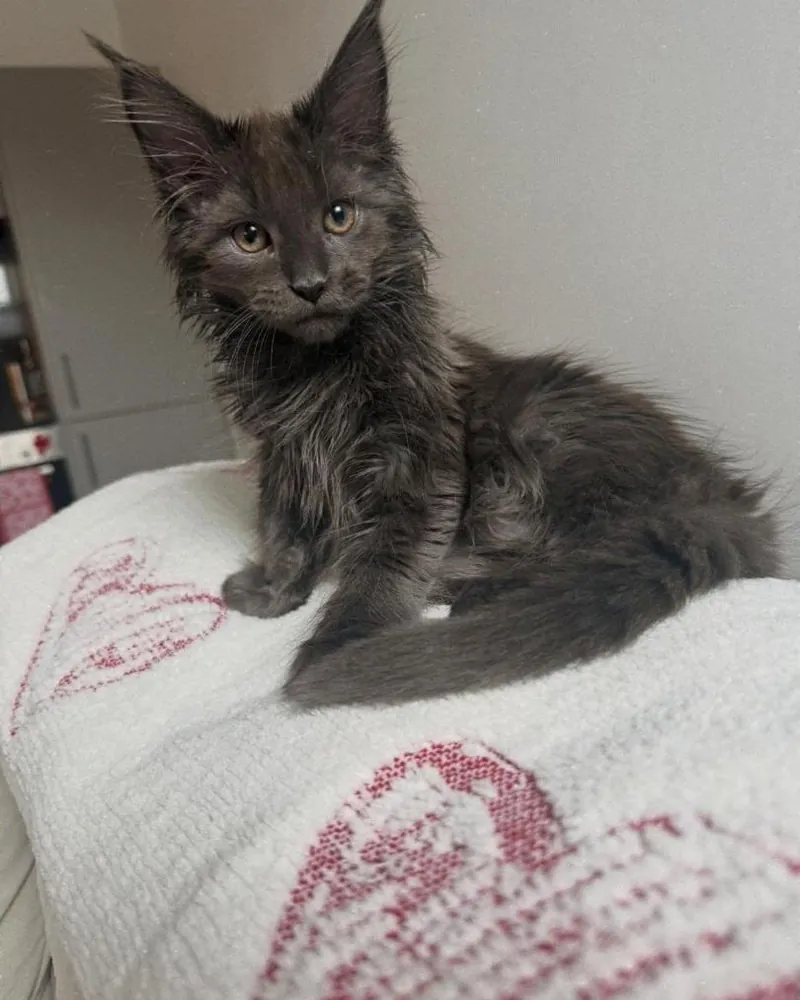
Small, round and fluffy, which is why the later size comes as a shock. A kitten at eight to twelve weeks is only a couple of pounds, and nothing about a little ball of fluff shows how large the adult will be. The next few months go fast.
When you look at kittens, judge what you can actually see: sturdy legs, large paws, a good appetite, a clean coat and lively play. Our available Maine Coon kittens are raised in the house with Cassie's family, children and a dog, so they are used to being handled, and every kitten is seen by a vet, vaccinated, dewormed, microchipped and spayed or neutered before going home.
Does a bigger Maine Coon cost more to keep?
A bit, though less than most people expect. A larger cat eats more, needs a bigger litter box, a sturdy tree and a carrier that actually fits. Medications and some vet items are dosed by weight, which adds a little.
The larger expense is usually the purchase, and size is only one part of why a kitten is priced as it is. Our Maine Coon price page explains what is included. For the shape of the whole breed, the Maine Coon guide hub is a good next stop.
Aim for a healthy weight, not a record. You should feel ribs under a light layer of padding, and you should see a waist from above.
Quick Answers
01Are Maine Coons the largest domestic cat breed?
They are widely described as one of the largest, and the longest recorded domestic cat was a Maine Coon. Some other breeds, such as the Savannah or the Ragdoll, can match them in weight, so "largest" depends on how you measure.
02How long is a full-grown Maine Coon?
Many adults measure about 30 to 40 inches from nose to tail tip, with the tail making up a large share of that. Longer records exist, but they are rare.
03Is my Maine Coon kitten too small?
Not necessarily, since kittens grow in bursts and the chart above is only a guide. If your kitten is bright, eating well and gaining over several weeks, it is probably fine. Ask your vet if weight stalls or drops.
04Can a Maine Coon be a lap cat at that size?
Many are happy to sit beside you or across your legs rather than on a small lap. Plan for a cat that expects a decent share of the couch.
05Do indoor Maine Coons get bigger?
Indoor cats do not grow taller, but they can put on more fat if they are overfed and under-exercised. Measure portions and give them room to climb and play.
Maine Coon Kittens Available Now


Keep Reading
Giant Maine CoonsHow big they really getLearn more
 How Long Do Maine Coon Cats Live?How long do Maine Coon cats live? About 10 to 13 years on the evidence.Read the guide
 What Do Maine Coon Cats Eat?What do Maine Coon cats eat, and how much? Kitten and adult feeding, wet versus dry food, water, weight and treats,...Read the guide
 European Maine Coon vs American Maine CoonWhat a European Maine Coon is, how it compares with an American Maine Coon in look and temperament, and why it is one...Read the guide
Maine Coon PriceWhat a kitten costs and what is includedLearn more
Available KittensMaine Coon kittens for sale nowSee the kittens
European Maine Coon vs American Maine CoonWhat a European Maine Coon is, how it compares with an American Maine Coon in look and temperament, and why it is one...Read the guide
Maine Coon PriceWhat a kitten costs and what is includedLearn more
Available KittensMaine Coon kittens for sale nowSee the kittens
When You Are Ready
Thinking About a Maine Coon Kitten?
See the kittens available now, or ask us anything about the breed.